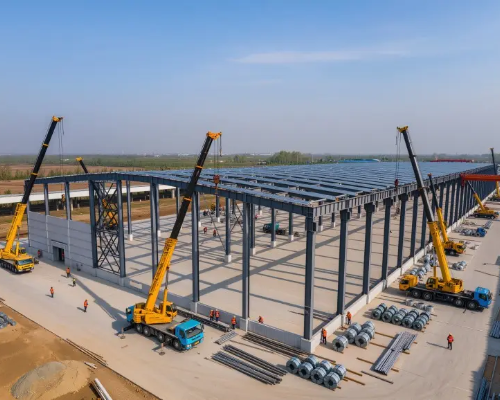
1. The Paramount Importance of Structural Safety
Constructing massive industrial work sheds, manufacturing plants, and heavy-equipment warehouses demands uncompromised adherence to structural engineering standards. Industrial facilities must safely withstand extreme environmental forces, including severe wind pressure, seismic ground motion, crane dynamics, and thermal expansion stresses without structural fatigue or deflection failure.
2. Advanced Finite Element Modeling & Load Calculation
At CODEX, structural engineers utilize 3D Finite Element Analysis (FEA) software to simulate complex multi-directional load combinations based on national building codes (such as IS 800, IS 875, and AISC standards):
- Dead & Live Load Distribution: Accounting for roof sheet weight, solar panel installations, ducting, and maintenance personnel movement.
- Dynamic Wind Pressure Simulation: Modeling wind velocity pressures up to 180 km/h with localized suction coefficient calculations at eaves and ridge corners.
- Seismic Ductility Framing: Designing moment-resisting frames with high-ductility connections to absorb and dissipate seismic energy during earthquake events.
3. Rigorous Quality Assurance & Site Erection Protocols
Safety extends beyond software calculations into material sourcing and job-site execution:
- Ultrasonic & Radiographic Weld Testing: Non-Destructive Testing (NDT) verifies full-penetration butt welds on heavy crane runway girders.
- Precision Torque Bolt Installation: High-strength friction grip (HSFG) grade 8.8 and 10.9 structural bolts are tightened using calibrated torque wrenches.
- Zero-Harm Site Erection Culture: Mandating certified rigging cranes, fall arrest safety netting, double-lanyard harnesses, and continuous site safety supervision during high-structure assembly.